
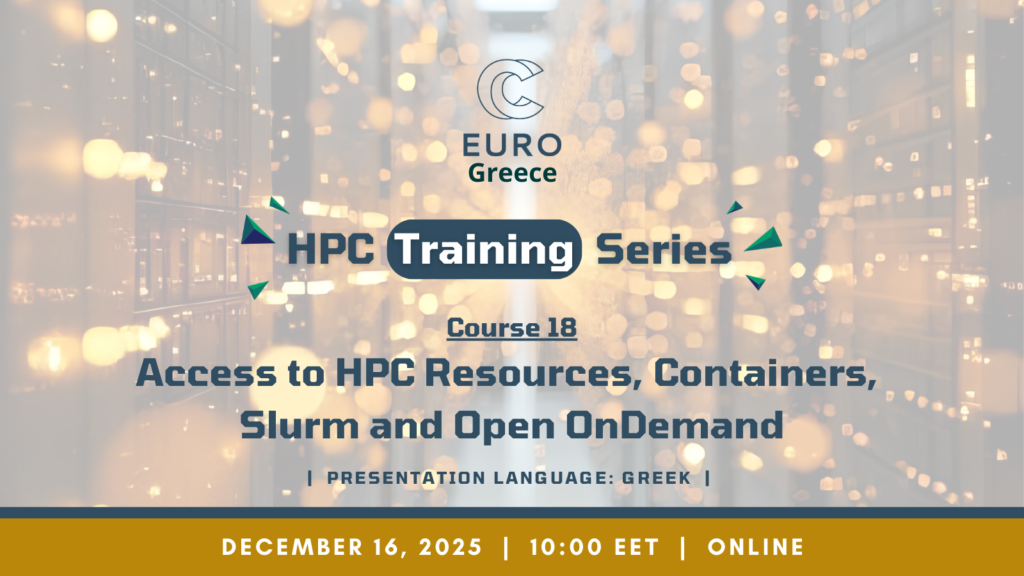
EuroCC@Greece announced the 18th Course of HPC Training Series with the subject “Access to HPC Resources, Containers, Slurm and Open OnDemand”, that took place online on December 16th, 2025.
Presentation language: Greek
Audience: Suitable for students, researchers, engineers and professionals with little or no prior HPC experience.
Location: Online via Zoom
This seminar gives a practical, step-by-step introduction to accessing and using HPC resources. Starting from your laptop, we move to Greek national systems and EuroHPC-JU machines. We begin with the European HPC landscape and how to obtain access. Then we cover SSH tools (PuTTY, MobaXterm, OpenSSH), key generation and secure login to HPC login nodes. Next, participants install and use a Docker-based Slurm environment locally, so they can experiment safely with a batch system: submitting first test jobs and understanding what a job scheduler does. We then go through basic Slurm commands (srun, sbatch, squeue) and run a simple script on a single node. After that, we look at the structure of a minimal Slurm batch script for an MPI job. We prepare, upload and run a container workload on HPC ARIS. Finally, we introduce Open OnDemand, showing how to log in via the browser, manage files, and launch interactive sessions and simple applications.
Learning Objectives:
By the end of the Seminar, participants were able to:
- Describe the basic concepts of HPC resources in Greece and EuroHPC-JU, and how access is organized.
- Use SSH tools (PuTTY, MobaXterm, OpenSSH) to generate keys, upload them and connect to an HPC login node.
- Install and use a Docker-based Slurm environment for local experimentation.
- Submit and monitor basic Slurm jobs using srun and sbatch.
- Recognize the structure of a simple Slurm batch script for an MPI job (job name, resources, run line) without needing MPI knowledge.
- Understand the main elements of a simple Open OnDemand application.
- Understand how containers are prepared, uploaded and used on an HPC system.
The course’s agenda and presentation material can be found here.
Watch the event’s recordings in the dedicated playlist here.