
DosimetrEYE: A GenAI-based tool for 3D preclinical dosimetry from 2D dynamic imaging
Presentations (PDF)
Organisations involved
Short description of the experiment
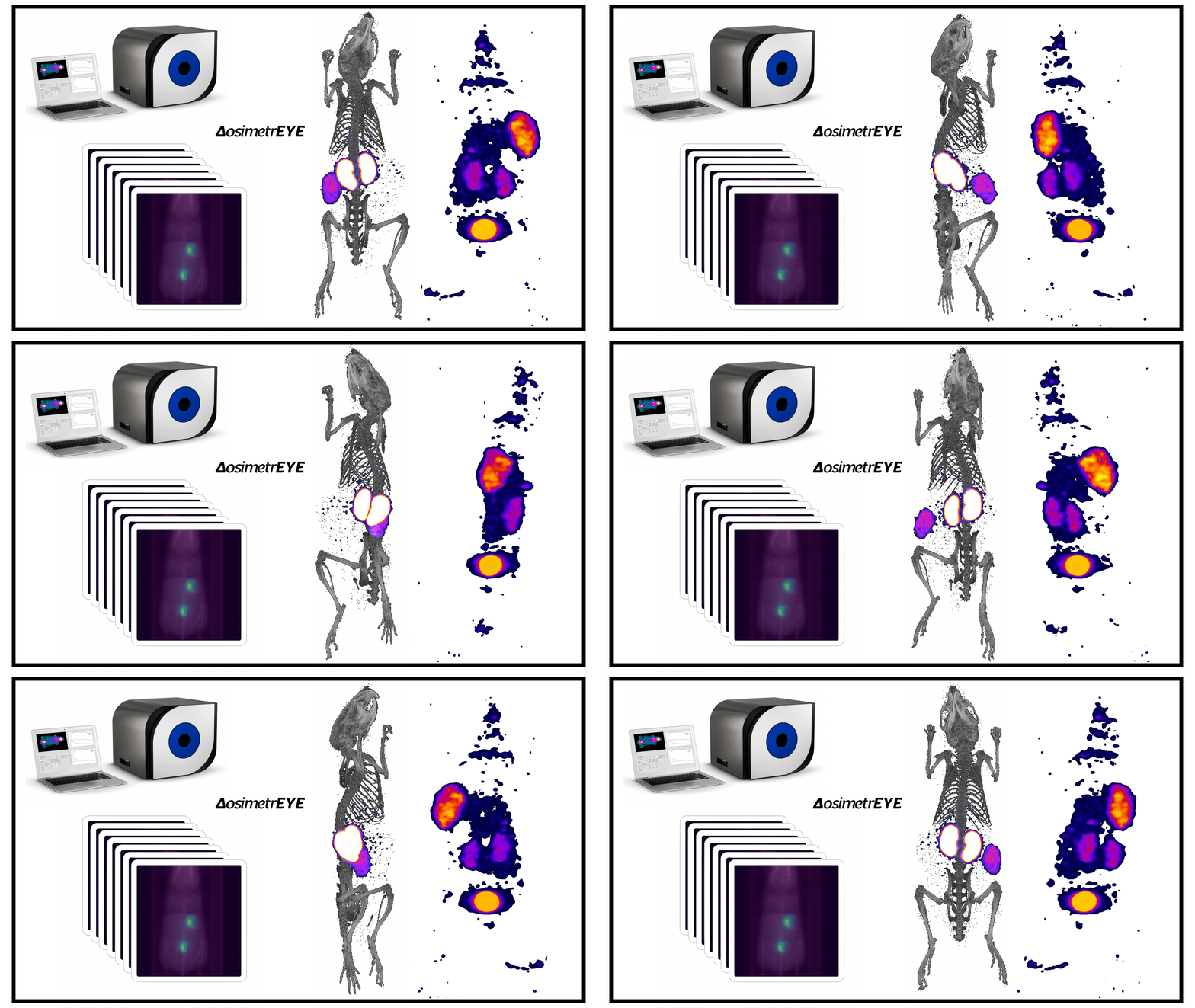
The DosimetrEYE innovation study designed, developed, and validated an end-to-end GenAI framework that can predict preclinical absorbed-dose (3D dose maps) from 2D planar nuclear imaging, enabling near real-time dosimetry during imaging acquisitions on BIOEMTECH’s eyes™ systems. To build reliable ground truth, the consortium curated and preprocessed almost 1000 small-animal SPECT/CT imaging datasets and generated corresponding 3D dose maps via large scale GATE Monte Carlo simulations on the LEONARDO HPC system. These paired data were used to train 2D-to-3D generative AI models, while quality-control and explainability (outlier detection/XAI) tools were integrated to support trustworthy deployment.
Outlook
DosimetrEYE is expected to progress from a validated prototype to a productized capability by integrating the GenAI dosimetry module into BIOEMTECH’s eyes™ preclinical imaging systems, and by offering it through CRO and SaaS-style services.
Next steps include further hyperparameter optimization, dataset expansion, and generalization to additional isotopes beyond In-111 (e.g., Lu-177, Ga-68, F-18, Tc-99m), which is expected to require additional HPC resources.
In parallel, the pipeline will be strengthened through further validation and extension of ALETHIA’s data-inspection, outlier-detection, and XAI tooling (Obz AI) for robust deployment and EU AI Act–aligned monitoring.
Beyond the FFplus study, the approach is intended to generalize across other imaging scanners and support longer-term clinical translation directions.
Lessons learned
HPC made the project possible at scale. It greatly reduced the time needed for Monte Carlo simulations and for training GenAI/AI models, letting us produce solid, high-statistics results within a few hours and with low uncertainty.
We also learned to plan around the realities of a shared cluster (queues, time limits, and maintenance). To avoid delays, it helped to keep “backup” work ready—such as preparing datasets or doing pretraining—when the cluster was not available.
Another key lesson was that automation matters a lot. Scripted, parallel workflows made the pipeline faster, more reliable, and easier to reproduce.
Finally, the experience expanded our capabilities: we learned to use HPC for more applications (including ML/DL with large imaging datasets), trained staff to build strong internal know-how, strengthened future proposal submissions, and started making HPC part of everyday work. We also plan to extend HPC access beyond DosimetrEYE, including Monte Carlo simulation needs in our products.
Expected impact
Society
DosimetrEYE provides a fast and robust way to estimate organ-level absorbed dose during preclinical radionuclide studies, with strong potential to support future clinical translation and personalized dosimetry (optimizing administered dose and minimizing radiation risks).
By enabling in vivo, AI-assisted dose estimation, it can reduce the need for ex vivo analyses and animal sacrifice (reported potential up to ~80%), supporting ethical and sustainable biomedical research goals.
Business
For end users (preclinical imaging labs, CROs, pharma/biotech, and academia), the main benefit is much faster dosimetry—from hours to seconds—plus improved precision/reproducibility and fewer animals required, which speeds up decisions and study turnaround.
For BIOEMTECH and the wider market, the results enable a market-ready feature (real-time 3D dosimetry) that can be integrated into eyes™ systems and offered via CRO, reducing per-study costs (~60%), increasing throughput, and opening new B2B/licensing opportunities with imaging vendors and partners.
Exploitation roadmap
Product integration (eyes™ systems): BIOEMTECH will embed the DosimetrEYE GenAI module into its eyes™ small-animal imaging systems so users can generate 3D absorbed-dose maps in real time during imaging acquisition, differentiating the product portfolio with AI-based quantitative dosimetry.
Service route (SaaS / CRO): In parallel, the DosimetrEYE AI engine will be offered as a stand-alone digital dosimetry solution, either as a cloud/SaaS offering or through BIOEMTECH’s CRO services, where customers can upload 2D images for automated 3D dosimetry estimation with usage-based fees.
Go-to-market and partner roles: BIOEMTECH will lead commercialization and client acquisition (leveraging its existing installed base), while ALETHIA will support deployment via licensed XAI/data-quality modules for transparency and EU AI Act–aligned compliance, and GRNET will provide long-term HPC expertise/access to support ongoing retraining and evolution.
Scale-up and extension: Next development steps include generalizing the model to multiple isotopes (e.g., Lu-177, Ga-68, F-18, Tc-99m) and expanding the dataset, which will require additional HPC resources; data-inspection modules will also be further validated to ensure robust deployment.
IP & B2B opportunities: The project anticipates new IP to be protected via patent and trademark applications, and the approach is expected to support B2B exploitation by extending/generalizing the software for use in other preclinical (and potentially clinical) imaging systems, including uptake by other device vendors.