

ASOB: Aerodynamic and Structural Optimization of modular Bicycles using HPC
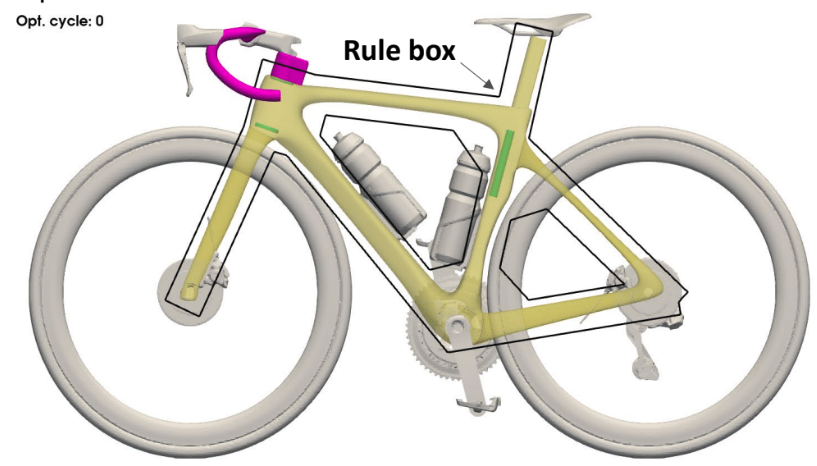
With the frequent changes in road cyclingregulations, the existing design workflow formanufacturingpersonalized road racing andtriathlon bicycles, using Carbon Fiber ReinforcedPolymer (CFRP) components, relies solely onstructural analysis with limited computationalresources. This setup lacks the agility needed tomeet market demands for high-performancebicycles at competitive prices. To address this issue,thisexperiment plansto enhance the workflow byintegrating aerodynamic and structural analysis andoptimization. This improvement will require theadoption of HPC resources, which areup to recentlynot been widely unavailable.
Presentations (PDF)
Organisations involved
| End User: Advanced Engineering | Organisations involved Domain Expert: NTUA , Politecnico di Milano , FOSS | HPC Provider: LUMI |
Short description of the experiment
Advanced Engineering (AE) is a growing SME, established in Greece, that specializes indesigning and manufacturing personalized road racing and triathlon bicycles, with CarbonFiber Reinforced Polymer (CFRP) components. With road cyclingregulations frequentlychanging, the existing design workflow, involving only structural analysis within the limitedcomputational resources available to AE, is not agile enough to meet market demands for thedesign of bicycles that offer superior performance at a competitive cost. To address this, AEaims to enhance its workflow by integrating aerodynamic and structural analysis andoptimization, necessitating the adoption of HPC resources, which are currently unavailablewithin the company and for which there is no existing expertise.In ASOB, AE’s structural analysis and CFRP expertise is combined with the CFD andoptimization excellence of the National Technical University of Athens (NTUA), Politecnico di Milano (PoliMi) and FOSS (another Greek SME) andthe HPC resources provided by theEuroHPC JU, to form an effective and efficient HPC-assisted aerodynamic/structural designworkflow. AE plans to use this workflow to design, not only triathlon or road racing but, also,modular bicycles that can act as both, by changing a few components. This will enhance itspresence in both the competitive and recreational cycling markets.
Outlook
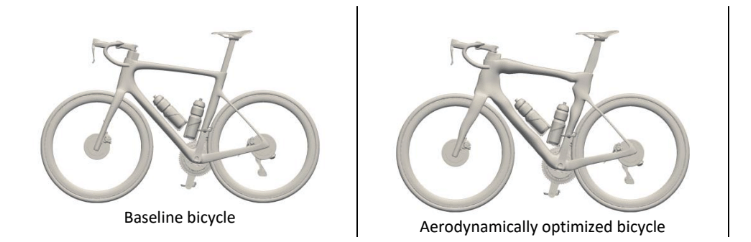
Work already done in ASOB has led to a considerable improvement of the aerodynamicperformance of two bicycles of different sizes, designed by AE. In specific, a consistentreduction of about 0.5 N (more than 8% of the baseline value) has been observed at fourdifferent operating points, defined by the bicycle and wind speed and angle. This places thenewly designed bicycles among the best performing ones available in market. With work onaerodynamic optimization gradually being finalized, ASOB will now focus on the structuraloptimization of the new shape, to reduce weight, increase the lateral stiffness (increasedperformance) and improve vertical compliance (ride comfort), in addition to making sure thatthe designed bicycles meet ISO certifications and Union Cycliste Internationale (UCI)limitations
Lessons learned
Theuse of HPC has been pivotal to the success of ASOB. Aerodynamic optimization is tooexpensive to run on the hardware available to AE, making it practically infeasible without theuse of HPC. The hardware provided by EuroHPC and, in specific, the LUMI cluster hasallowed a complete, multi-point aerodynamic optimization in less than 24 hours. This processwould have months to complete using the manual trial-and-error approach followed by AE toaerodynamically design its bicycles. Additionally, a positive surprise was the availability ofthe hardware at LUMI. Even when requesting thousands of CPU cores for high fidelityvalidation runs, the waiting time in the queue was practically zero, further reducing the realtime needed to reach an optimized solution.
Expected impact
Society
Cycling provides a variety of health benefits and reduces the risk of cancer, heartdisease, and diabetes that are prevalent in sedentary lifestyles. It is very popularworldwide and especially in the EU, acting both as a means of green transportationand as a sports/hobby activity. This includes bicycles for transportation, mountainbiking, road racing and triathlon. Road bicycles are built for traveling at speed onpaved roads and, apart from road racing, are nowadays frequently usedforrecreational cycling too, since cycling enthusiasts seek advanced and personalizedequipment. Though ASOB mainly focuses on performance bicycles built for racing, technology developed during this project (especially results related to structuraloptimization) can gradually migrate towards bicycles built for everyday use
Business
The above-mentioned technical advancements will have a multi-faceted impact on thecompetitiveness of AE in the cycling market. To begin with, the time-to-market ofAE’s bicycles, following the trial-and-error workflow mentioned earlier, may be ashigh as one year (including the process of making the molds for the CFRP materials)and is expected to be reduced by about 50%, using the HPC workflow of ASOB. Thiswill allow AE tokeep up with changes in the regulations and attract a wider range ofprofessional athletes as well as to avoid fending off cycling enthusiasts, due to a longdesign and manufacturing process. Additionally, the shortened design phase willallow AE to significantly reduce the cost associated with designing the bicycle, by anapproximate 50% (from 250K to 125K €, through the reduction of the person-monthsof skilled engineers involved in their design). This will facilitate the price reductionof its mid (from 13K to 11K €) and top (from 20K to 17K €) tier bicycles, enhancingtheir competitiveness (~20% cheaper than equivalent TREK models). Owing to thebetter performance and reduced price, AE expects to be able to sell 50 extra bicyclesper year, increasing its yearly profit by 300K €. In addition, the expected increase inthe competitiveness of AE is projected to create 2-3 highly skilled jobs in the yearfollowing the end of the project, including engineers utilizing the HPC workflow tobe created in ASOB and technical stuff working on the manufacturing of theincreased number of bicycle orders.
Exploitation roadmap
Upon completion of the project, AE plans to manufacture the designed bicycles and makethem available for sale. AE will exploit the results of ASOB by both using its existingchannels and creating new ones. In specific, AE is collaborating with world class athletes andcoaches, like V. Krommidas (Multiple years World Record holder in Hawaii, Olympic Gamesparticipant, Multiple Times Champion) and C. Garefis (Multiple times World and EuropeanChampion, 17 Gold, 1 Silver, 2 Bronze medals), who will test the bicycles designed throughthe workflow of ASOB, testify about their technical performance and inform their traineesand federations about AE’s potential of designing highly efficient, personalized bicycles. AEwill also use its presence on social media to actively promote the products and designcapabilities enabled through ASOB. The experience gained by applying for computationaltime in EuroHPC systems will be exploited by AE in future projects.