

Overview
The presented methodology formalizes the procedures, assessment criteria, and tools that NCC Greece uses to assist SMEs seeking HPC access. The methodology aims are two-fold: to help SMEs better navigate the extensive documentation and resources that are made available by the EuroHPC JU; and to document NCC procedures so they can be followed independently by any NCC consultant.
Objectives
Internal objectives (for NCC consultants)
- Ensure consistent intake and eligibility checks for SME HPC requests.
- Describe assessment criteria and SME maturity concepts.
- Standardize tool use and reporting so any consultant can continue a case without loss of context.
- Maintain reproducible consultation procedures.
External objectives (benefits for SMEs)
- Faster, clearer access to appropriate EuroHPC resources and service offerings.
- Reduced HPC access time through documented steps and predictable support.
- Reliable outcomes, such as successful access applications, clear view on scope and expected deliverables, roadmaps for follow-ups and next steps.
Key Barriers to HPC Access
Arguably, SMEs that require consultancy on how to access HPC machines, face some of the following, occasionally cumulative, set of challenges:
Table 1: SME HPC Access Challenges Tiers
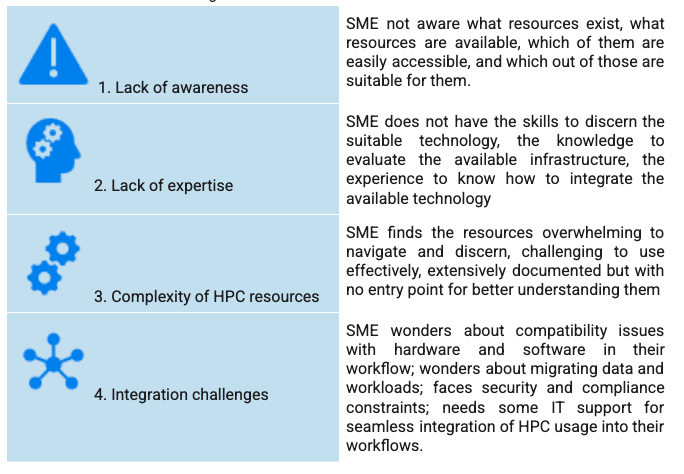
An additional challenge, orthogonal to the above categories, may be lack of funding: a challenge in which the SME does not have the budget for initial HPC investment, or cannot afford to secure funding for necessary training and expertise. In case an SME presents with such a challenge, it is up to NCC consultants to determine whether this challenge affects access to HPC machines or whether it should be addressed under different methodologies.
It is useful for NCC consultants to understand the implications of each of these challenges in order to best assess the SME needs and better support them in their HPC access journey.
Strategy

Approach
- Assess & segment: profile SME (discern industry sector, workload type, data size, software stack, skills, timelines, budget) and classify into a challenge tier (cf. with Key Barriers to HPC Access)
- Match resources & plan: determine hardware needs and recommend HPC machine. Depending on challenge tier and desired application, map SME needs to a suitable HPC access mode. Based on recommended access mode, create a tailored, time‑boxed access plan (milestones to complete for successful application, expected timeline from submission to acceptance notification to machine access, application success criteria).
- Standardized, modular toolkit: provide reusable access application templates and application guidelines that can be used by the SME to submit an application quickly. Provide tools such as comparative technical overview of available machines.
- Hands‑on onboarding & validation: assist in application submission, providing feedback and corrections on the SME’s draft. Recommend suitable hardware if necessary.
- Feedback loop & continuous improvement: maintain contact with SME up to and after access is granted. Collect metrics (application text characteristics, how many applications to success, user satisfaction, etc), incorporate lessons into NCC methods toolkit, and update templates and NCC personnel training.
Target audience
- HPC-mature SMEs that have either never used HPC before or that are unaware of EuroHPC JU resources and infrastructures.
- SMEs that are aware of EuroHPC JU infrastructure but need assistance in navigating the plethora of EuroHPC JU resources in order to successfully apply for access.
- SMEs that are aware of infrastructures and familiar with resources and access modes, but need technical assistance, e.g. in determining the appropriate machines for their needs.
Outcomes
- Establish clear criteria for selecting access mode and HPC machines.
- Provide concise steps for applying for access to HPC resources.
- Assist in access application writing, so that the application adheres to the specific objectives and aligns with the overall SME goals.
Roles
The personalized method of NCC Greece relies on the following roles to be carried out successfully:
| Role | Responsibilities |
|---|---|
| Consultant | NCC personnel that are knowledgeable in the available HPC ecosystem, accessible supercomputer infrastructures, EuroHPC JU access modes, SME HPC needs assessment, as well as challenge tiers and access criteria. |
| Technical expert | HPC expert with experience in the particular sector that the SME is active in and/or experience in the technology frameworks that the SME plans to use. |
| Communications | Manage correspondence with SME, keep track of meeting history, arrange consultation appointments. |
Indicative activity sequence and interaction of those roles and the SME is as follows:
Establish contact: Either the SME reaches out to the NCC or the NCC scouts and approaches an SME that has the suitable maturity or can benefit from HPC use. The SME scouting can be done by either role. Once contact is established, Communications arranges for a consultation. This consultation is commonly carried out via a teleconference. An NCC consultant is assigned to the SME.
Profile SME: The SME profiling is carried out by the Consultant in two steps, the offline and the online step. The offline step takes place before the consultation and consists of determining the sector the SME is active in and in familiarizing with the SME’s website, products, and area of activity. This offers a first estimate of the placement of the SME on the challenges tier and helps the Consultant prepare a possible HPC access mode proposal for the SME. The online step takes place during the consultation, where the Consultant interviews the SME regarding their personnel expertise, product characteristics, and technology needs. This forms a fuller picture of the SME and aids in the decision of what access mode to propose.
Technical consultation: On occasion, an SME may face tougher challenges at tier 4. Then it may need a more specific, technical consultation to determine the access mode and HPC machine that may be suitable for it. This consultation may be carried out by the Consultant in collaboration with the Technical expert, to better assess the SME’s technical needs and offer a more tailor-made recommendation of HPC machine to aim for.
Application support: Once the desired HPC infrastructure as well as the indicated access mode have been determined, the Consultant assists the SME during the application process. This mostly consists of the SME creating application drafts and forwarding them to the Consultant for feedback and corrections. The Consultant may confer with the Technical expert in order to revise the sector- and technology-specific sections of the application.
Access support (optional): Once an SME has been granted access to an HPC machine, the NCC may offer, if requested, some additional, high-level support with the actual access and use of the HPC machine. The Consultant or the Technical expert may help the SME understand the HPC cluster environment, assist with understanding the available software, and help the SME orient themselves regarding resource usage. In essence, the NCC helps the SME in understanding and using the HPC infrastructure’s user documentation.
Follow-up (continuous): Once one such access cycle has been carried out by the NCC and the SME, Communications keeps in periodic touch with the SME. The goal is to assess further SME needs, guide towards and propose future HPC use, and inform of new developments in access modes and available resources. Should useful opportunities arise for further HPC use, the step sequence is followed once more for the SME’s subsequent project.
We remark that this procedure can be followed again from the start, albeit with the necessary improvements and refinements, in case the access application is not initially successful.
We further remark that, although the procedure requires the aforementioned roles, it may well be that the same person or persons carry out more than one of those roles.
Resources
| Resource | Purpose | Link / Reference |
| Indicative User Journey | Drafted by the NCC to illustrate to SMEs the sequence of steps to follow for machine access; provides understanding of estimated timeframes. | https://eurocc-greece.gr/how-to-apply-for-access-to-eurohpc-ju-supercomputers/ |
| EuroHPC JU Supercomputers overview | Provides the SME with a starting point from which they can access individual documentation of each EuroHPC supercomputer and obtain information regarding available hardware and software frameworks. | https://www.eurohpc-ju.europa.eu/supercomputers/our-supercomputers_enhttps://eurocc-greece.gr/how-to-apply-for-access-to-eurohpc-ju-supercomputers/ |
| EuroHPC JU Access Modes overview | The EuroHPC webpage as well as the application access portal provide the user with the detailed specifications of each access call, specify call deadlines, and indicate timeframes. | https://www.eurohpc-ju.europa.eu/supercomputers/supercomputers-access-calls_enhttps://access.eurohpc-ju.europa.eu/ |
| Bookmarks to technical specs | Drafted by the NCC for two purposes: i) to offer a shortcut to the webpages that provide the technical specifications of each European supercomputer; and ii) to allow the SME to easier compare the infrastructure characteristics and help them choose a suitable machine for their needs. | Internal list, continuously maintained, provided to the SMEs via e-mail, i.e. on-demand, as a follow-up to initial consultations. |